On July 31, 2025, Washington Gas filed an application with the Virginia State Corporation Commission on June 29, 2022 requesting an increase in rates of $65.3 million, in addition to the transfer of $38.7 million of the costs of investments in infrastructure replacements made pursuant to the Company’s Steps to Advance Virginia’s Energy Plan (“SAVE Plan”) from the SAVE Rider to base rates, i.e., a total increase in rates of $104.0 million.
The preliminary review of the revenue request notes that the average increase in distribution costs for members is 30-35%, which would result in a approximate 15-20% increase in total Washington Gas Virginia bills beginning in January 2026.
AOBA will intervene in the rate case and provide more information for members as the case proceeds.
AOBA will be hosting a Utility Rate Case and Energy Market Update on August 21, 2025 at 11AM (virtual).
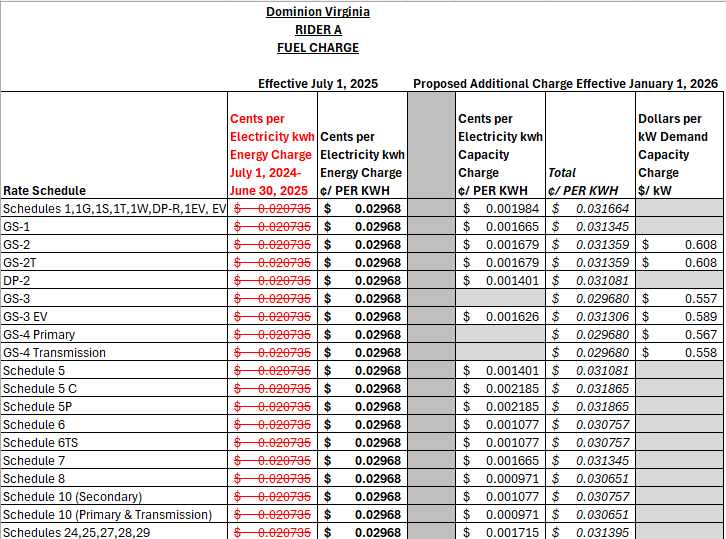
Dominion filedits annual fuel factor rate updatebeginning July 1, 2025 through June 30, 2026 in Virginia on March 31, 2025. The fuel factor rate, if approved, will be in effect from July 1, 2025 through June 30, 2026. Dominion projects fuel costs of $1.958 billion, including energy related fuel and capacity related purchased power expenses, for the coming fuel year combined with a prior period under-recovery of $204.5 million for a total revenue requirement of $2.1628 billion. The Fuel Factor is collected on customers’ bills under Fuel Charge Rider A. (See below).
Dominion is proposing a change to the components and calculation of the Fuel Factor beginning with this fuel year. Dominion has proposed adding a capacity component to the annual fuel factor. Dominion is requesting a change to the recovery of capacity costs incurred, which have been historically collected through base rates in Virginia. The proposed 2025 fuel factor is $0.02968 per kwh energy charge plus an additional kwh or kw demand charge depending on your rate class and load factor. The additional charge pushes the residential fuel charge to $0.031664 per kwh and commercial customers can expect a similar charge on their bills. (See chart below). For comparison, last year’s fuel charge was $0.020735 perkwh. This new charge, if adopted, represents over a 50% increase in the fuel charge. AOBA reviewed a sample building, and the new fuel rate would represent an approximate 8-10% increase to the total bill.
In its Application, Dominion proposed that the capacity expense changes become effective with the new base rate changes in the biennial review beginning January 1, 2026, and include approximately $120 million of purchased capacity expense incurred from January 1, 2026 through June 30, 2026 in the fuel factor.
However, on May 12, 2025, the SCC ordered that “a total fuel factor rate of 2.9680 cents/kWh, with no capacity component, may be placed into effect on an interim basis for usage on and after July 1, 2025.” The SCC excluded the proposed capacity component adjustment of the fuel factor pending its decision in the biennial review. The current fuel charge is 2.0735 cents/kWh and will increase on an interim basis to 2.9680 cents/kWh – a 43% increase.The fuel factor rate ultimately approved by the SCC could be higher than the interim fuel factor rate if the Company’s proposal to move capacity-related purchase power expenses from base rates to the fuel factor is approved. The SCC determined that a procedural schedule for this fuel factor proceeding should be combined for all purposes including discovery, pre-filed testimony and hearing dates, with the Dominion Biennial Review. Testimony is scheduled to be filed in both cases in July and August, with hearings to begin September 2, 2025.
The Virginia State Corporation Commission established a procedural docket combining both the fuel factor change and the biennial review of rates, to the extent possible, to expedite the process.
Dominion’s request for revenue requirement approval in calendar years 2026 and 2027, for notices purposes, assumes that the purchased capacity expense recovery remains in base rates and is not transferred to the fuel factor as of January 1, 2026. Once the Commission rules on moving capacity charges to the fuel rate from base rates, Dominion will update its revenue requirement, so there is no double-counting.
In the interim, the Commission has permitted Dominion to update the fuel factor, effective July 1, 2025 to $0.02968 cents per kwh, which does not include any capacity components. For reference, the current Fuel Factor is $0.020735 per kwh for all rate classes, a 43% increase.
Dominion filed a request for a $458 million base rate increase beginning January 1, 2026 and an additional incremental increase of $173 million beginning January 1, 2027 in Virginia (excluding capacity expense) on March 31, 2025.
Dominion filed its 2025 Biennial Review pursuant to Virginia’s updated ratemaking statute, the Affordable Energy Act. The Company is proposing a 10.09% Return on Equity which is well above industry medians, with a capital structure that relies on more than 52% equity. This proposed capital structure increases Dominion’s revenue requirements and shifts financial risk onto customers. Dominion has proposed a fundamental shift in cost allocation using the Average & Excess (A&E) methodology. This change disproportionately reallocates fixed and demand-related costs onto commercial rate classes, especially GS-3 and GS-4. A new GS-5 rate class is being introduced for exceedingly large customers with more than 25 MW of load, offering long-term contracts, minimum bills, and exit fees that shield the Company from usage volatility.
Revenue Rebalancing and Rate Increases
In addition to the above, Dominion characterizes its $67 million revenue shift from generation to distribution charges as “revenue neutral,” which is only true from the utility’s perspective. For customers, particularly commercial customers, the revenue shift results in real and material bill increases. Overall, the combined proposed distribution and generation rate increases for all customer classes is as follows:
Virginia Electric and Power Company
Base Distribution and Base Generation Revenue Changes to Customer Classes[1]
Class
2026
2027
Residential
23.8%
31.6%
GS-1
24.3%
30.4%
GS-2
21.3%
30.0%
GS-3
30.8%
36.6%
GS-4
29.7%
44.1%
GS-5
NA
55.1%
Special Contract
0.0000%
0.0000%
Church
33.5%
40.4%
Outdoor Lighting
31.0%
37.3%
These increases are not based on new service costs but instead reflect Dominion’s internal revenue reshuffling, and do not include the changes in the fuel rate and the anticipated capacity charges from PJM procurement.
Efficiency Disincentives and Market Distortion
The Dominion proposal penalizes conservation by increasing reliance on fixed charges. It weakens price signals that support energy efficiency and demand-side management, undermining the Virginia Clean Economy Act. Low-usage customers may see their bills increase, while high-consumption customers, especially those in GS-5, may benefit.
Statutory Conflicts and Ratemaking Deviations
The rebalancing proposal circumvents Va. Code § 56-585.1A, which prohibits rate increases during a biennial review. Dominion’s filing applies changes across nearly all tariffs, including adjustments not tied to class cost-of-service analysis. The 2021 rebalancing referenced by Dominion was part of a non-precedential settlement and tied to customer credits, not comparable to this proposal.
Disproportionate Impacts on Commercial Customers
Mid-sized commercial customers are caught between the protections of GS-5 contracts and residential rate smoothing. These legacy customers bear increased risk and cost exposure without meaningful offsets. Dominion’s proposal prioritizes its financial insulation over customer cost stability and affordability.
Conclusion
Dominion’s proposal is not merely a technical rate adjustment; it represents a fundamental shift in risk allocation. Commercial customers are being asked to subsidize speculative load growth while absorbing new pricing instability. AOBA intends to urge the Commission to reject these changes and preserve fairness and affordability in the ratemaking process for AOBA members.
[1] Dominion Witness C. Alan Givens, CAG, Schedule 1, pages 3 and 6.
On January 31, 2025, Pepco filed its annual Bill Stabilization Adjustment (“BSA”) in the District. The BSA was first implemented in January 2010. The rationale behind the BSA was to remove the link between electricity use and utility revenue. Until now, the more electricity customers used, the more revenues Pepco received. Pepco argued that the previous rate structure created a disincentive for the utility to encourage customers to conserve energy since it lowered Pepco’s revenues.
Previously, the BSA was adjusted monthly and contained a 10% cap provision so that the monthly charge could not exceed 10 % of the expected revenue from each rate class. The BSA accrues the amount of expected revenue vs. what Pepco has collected and the under collection is then billed to rate payers. The BSA balances have been accruing at a significant rate, especially for the GT_LV class, which has a balance of $56 million in uncollected revenue.
There have been several issues with the BSA that AOBA has testified about in the most recent Pepco rate case and other cases. Partly in response, the DC PSC authorized a change in the BSA in its most recent ruling:
PSC directed Pepco to remove $15.3M balance, due to Pepco errors in the BSA demand billing determinant factor
PSC also directed Pepco to create a regulatory asset to collect the BSA balances as of December 31, 2024 and collect those balances over the next 10 years.
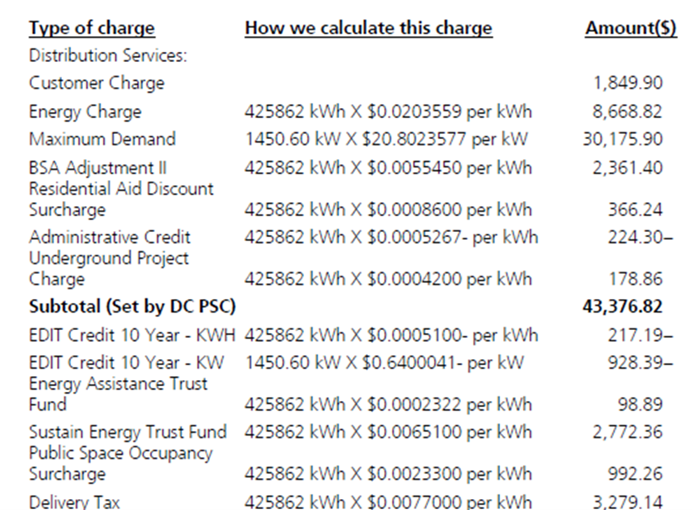
The new BSA charge will be an annual charge as a separate line item on customers’ bills to be collected from March 2025 through February 2026. This charge will be listed as BSA Adjustment II on the bill. For a sample office building on the GT_LV rate schedule, the new BSA represents an increase of ~ $14K annually.
There will be a BSA Adjustment I that will calculate the over/under collected revenue for CY 2025. This will be another line item on bills beginning March 2026 through February 2027.
AOBA and AOBA Alliance presented an update to the Pepco DC rate case, FC 1176. Pepco filed its compliance rates in December effective January 1, 2025. The compliance rates resulted in a 35% reduction in the original request by Pepco but buildings will see some large increases in their Pepco distribution bills in 2025.
AOBA Alliance, Inc. and Constellation held the quarterly energy market update informing participants about changes in the PJM Capacity market as well updating the status of utility rate cases in Maryland, DC and Virginia. If you would like more information or access to the Constellation presentation, please contact kcarey@aoba-metro.org
AOBA Utility Committee Meeting November 20 | 11 AM – 12 PM | via Zoom Register
Frann Francis, Senior Vice President and General Counsel for AOBA, and Kevin Carey, Vice President of AOBA Alliance, will update AOBA members on the ongoing rate cases in Maryland and D.C. and their impacts on budgets as well as other energy related issues impacting members and participants.
William Sticka, Director of Technical Sales/Market Strategy for Constellation, will present the market fundamentals impacting electric and natural gas pricing, updates on winter weather forecasts, PJM Capacity prices as well as purchasing strategies and opportunities for AOBA members and AOBA Alliance participants.
Pepco filed a request for a $31.0 million increase beginning May 1, 2025 in Maryland as the Company’s Final Reconciliation as a result of the last MYP approved in Maryland, i.e., Case No. 9655. AOBA was a party to that proceeding and will file testimony on October 18, 2024 as required by the Commission’s Order No. 91292.
Hearings will be held beginning December 17, 2024 and briefs and reply briefs will be filed in January, 2025. Implementation of reconciliation rates will be effective May 1, 2025.
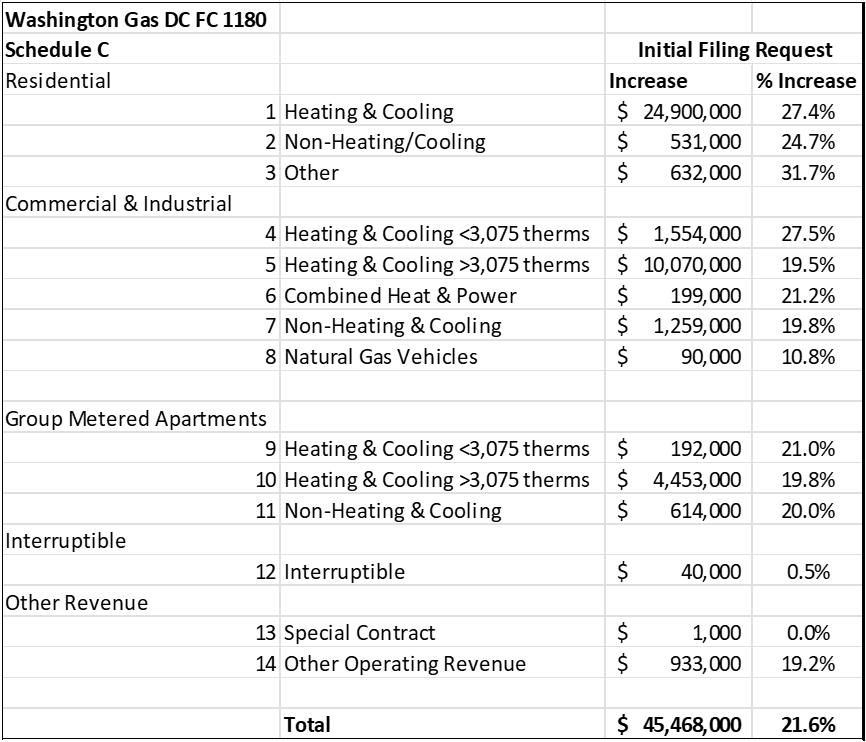
WG is requesting a $45.6 million increase in rates which includes a transfer of $11.7 million from the PROJECTpipes surcharge to base rates, for an incremental increase of $33.9 million.
WG proposes that new rates become effective June 1, 2025.
In WG’s last base rate case FC 1169, the PSC reduced WG’s request for a $53.0 million increase to $24.6 million, which became effective January 19, 2024.
WG’s proposed rate increase estimates for Commercial and Group Metered Apartment customers range between 20-28% in the Company’s new case.
Frann Francis, Senior Vice President and General Counsel for AOBA, and Kevin Carey, Vice President of AOBA Alliance, will update AOBA members on the ongoing rate cases in Maryland and D.C. and their impacts on budgets as well as other issues impacting members and participants including Building Energy Performance Standards.
William Sticka, Director of Technical Sales/Market Strategy for Constellation, will present the market fundamentals impacting electric and natural gas pricing, updates on the PJM capacity auction, and purchasing strategies and opportunities for AOBA members and AOBA Alliance participants.
If you would like to participate in the AOBA Alliance program or would like to receive more information, please contact Kevin Carey at kcarey@aoba-metro.org.